

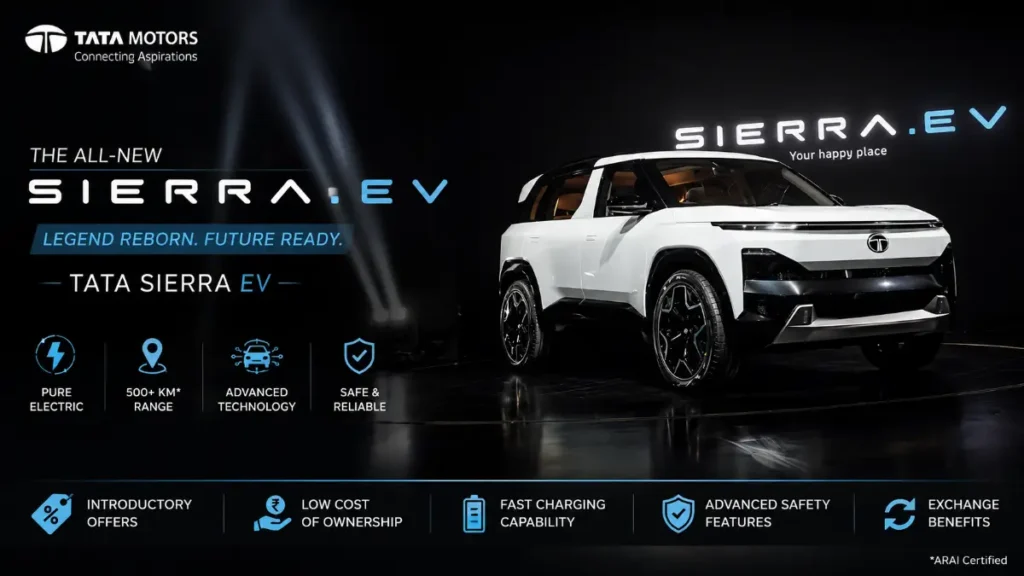
Tata Sierra EV India: Few car names carry as much emotional weight in India as Sierra. Tata Motors’ iconic Sierra was one of the most distinctive Indian cars of the 1990s, instantly recognisable with its three-door body and rear-quarter glass. Now, after more than two decades, the Tata Sierra is making a comeback — this time as a fully electric SUV. Expected to launch in May 2026, the Sierra EV is one of the most anticipated car launches of the year, and rightfully so.
Platform and Architecture
The Sierra EV is built on Tata’s advanced Gen 2 EV platform — the same underpinnings that underpin the Harrier EV. This gives it a significant engineering head start, with proven thermal management, charging infrastructure compatibility, and structural rigidity already validated in production vehicles. The Sierra EV will be positioned below the Harrier EV in Tata’s lineup, making it a more accessible electric option.

The platform supports both Rear-Wheel Drive (RWD) and All-Wheel Drive (AWD) configurations — a key advantage for buyers who want added traction capability without moving to a much more expensive SUV.
Expected Battery and Range
Tata is expected to offer the Sierra EV in at least two battery configurations:


- Standard Range: ~45 kWh battery, approximately 400 km range (ARAI certified)
- Long Range: ~60 kWh battery, approximately 500+ km range
Fast charging support of up to 100kW DC is expected, which would allow charging from 10% to 80% in approximately 35-40 minutes at a compatible charger. Home AC charging via a 7.2kW on-board charger is also expected as standard.
Design: Modern Tribute to the Original
The Sierra EV draws clear visual inspiration from the original model’s distinctive D-pillar and quarter glass treatment — now translated into a modern, aerodynamically optimised SUV form. The front features a closed-off grille (as befitting an EV), LED matrix headlamps, and a flowing hood line. The rear retains the signature visual identity with a wraparound light bar.
Dimensionally, the Sierra EV is expected to measure approximately 4,300mm in length — placing it between the Nexon EV and the Harrier EV in terms of size.
Features and Technology
- Tata’s latest iRA connected car technology with OTA updates
- Panoramic glass roof (expected on mid and top variants)
- ADAS Level 2 suite including automatic emergency braking, lane keep assist, adaptive cruise control
- 10.25-inch floating touchscreen infotainment
- Digital driver’s display (instrument cluster)
- Ventilated front seats on top variant
- 360-degree surround view camera
- Vehicle-to-Load (V2L) charging capability expected
Expected Price
| Variant | Expected Price (Ex-Showroom) |
|---|---|
| Smart (Standard Range, RWD) | Rs 20.00 – 21.00 lakh |
| Pure (Standard Range, RWD) | Rs 21.50 – 23.00 lakh |
| Accomplished (Long Range, RWD) | Rs 23.50 – 25.00 lakh |
| Empowered+ (Long Range, AWD) | Rs 26.00 – 28.00 lakh |
Tata Sierra EV vs Rivals
| Model | Price | Range | Key USP |
|---|---|---|---|
| Tata Sierra EV | Rs 20–28 lakh* | ~400–500 km | Iconic design, AWD option, value |
| Hyundai Creta Electric | Rs 17.65–23.50 lakh | ~473 km | Features, brand trust |
| Mahindra BE 6 | Rs 18.90–26.90 lakh | ~682 km | Longest range, performance |
| MG Windsor EV | Rs 13.50 lakh onwards | ~331 km | Affordable, battery rental |
*Expected prices, to be confirmed at launch
MotorFocus Verdict: The Tata Sierra EV has everything needed to become a bestseller — an emotional nameplate, competitive pricing, proven platform, and AWD option at a reasonable premium. If Tata delivers on the 500 km range claim at the expected Rs 25 lakh price point, it will be one of the best value EVs in India and could outsell even the popular Creta Electric in its first year.




Leave a Feedback