
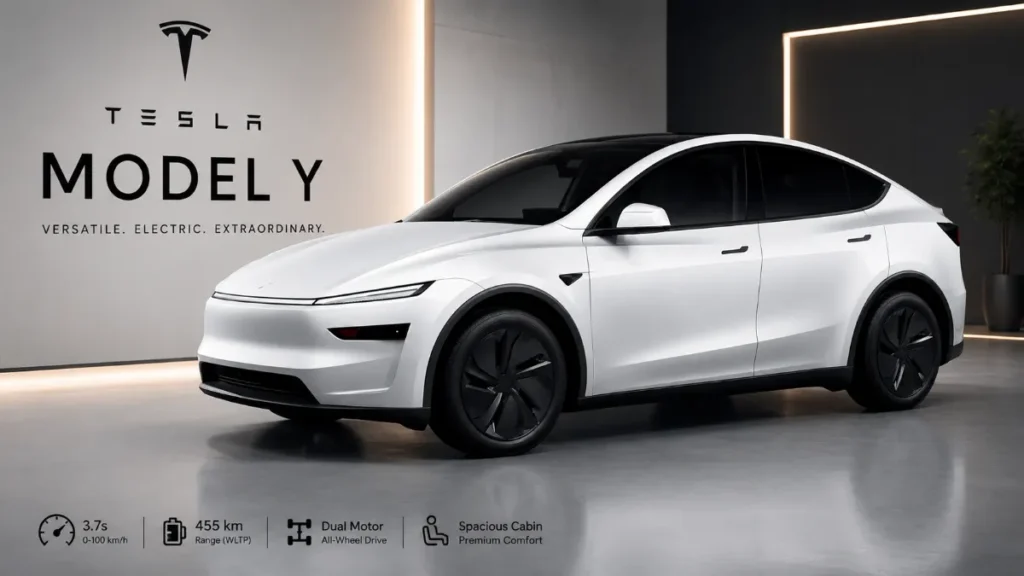
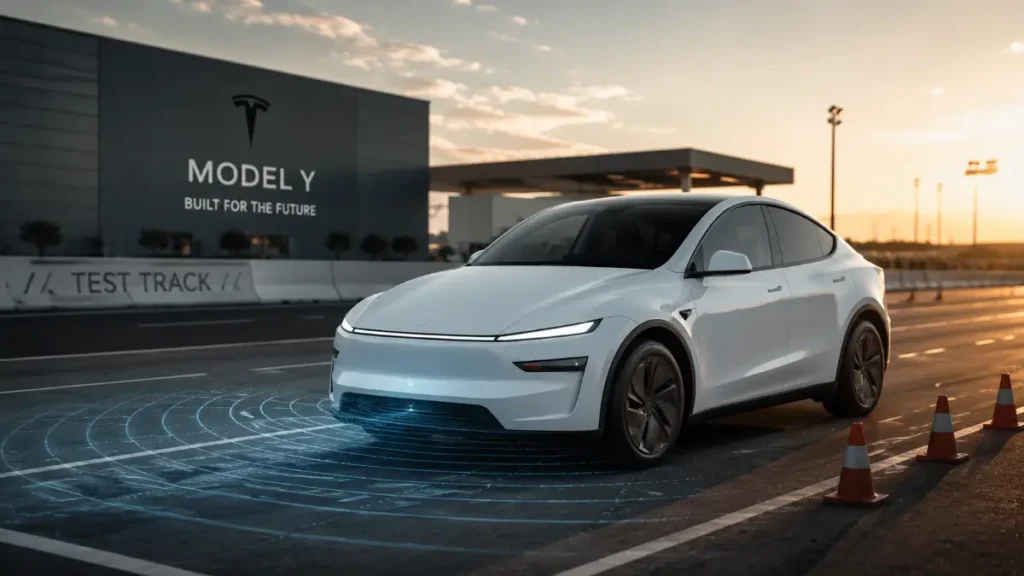
The 2026 Tesla Model Y NHTSA ADAS test result has just rewritten the rulebook for vehicle safety certification in the United States. On May 7, 2026, the National Highway Traffic Safety Administration confirmed in a joint statement with the Department of Transportation that the later-release 2026 Model Y is the first vehicle in history to pass the agency’s expanded Advanced Driver Assistance System benchmark under the updated New Car Assessment Program.
The certification arrived 24 days after Tesla’s Q1 2026 earnings call and one day before the May 8 implementation of new 25% European Union auto tariffs — timing that did not go unnoticed by industry watchers. But beyond the political backdrop, the technical achievement is real: eight separate ADAS performance evaluations cleared without a single failure, including four newly added pass/fail tests that no other vehicle had previously been formally evaluated against under this framework.

For Tesla shoppers, owners, and EV buyers across America, this is a genuine milestone. For competing automakers including Toyota, Hyundai, Ford, GM, and Rivian, it sets a benchmark they will all be measured against starting with the 2027 model year. Let’s walk through exactly what happened, what it means, and what doesn’t change.
Quick Facts: 2026 Model Y NHTSA ADAS Test
| Item | Detail |
|---|---|
| Vehicle | 2026 Tesla Model Y |
| Certification authority | NHTSA (NCAP framework) |
| Announcement date | May 7, 2026 |
| Tests passed | 8 of 8 (4 new + 4 original ADAS criteria) |
| Eligible build date | November 12, 2025 onward |
| Base Model Y price | $39,990 (RWD) |
| Top trim | Performance, $57,490 (3.3-second 0–60 mph) |
| Range | 294–357 miles depending on trim |
| Overall star rating | Unchanged — pass/fail tests are separate from 5-star crashworthiness rating |
What the Certification Actually Means
NCAP, the New Car Assessment Program, is the government framework that produces the familiar five-star crash-test ratings printed on every new-vehicle window sticker. Until 2024, NCAP focused almost entirely on crashworthiness — how well a car protects you when an accident is happening. The new ADAS pass/fail tests added under a 10-year roadmap finalized in late 2024 do something fundamentally different: they evaluate how well a car prevents the crash from happening in the first place.

That is the conceptual shift worth understanding. A traditional five-star crashworthiness rating tells you how safe a car is once you have already lost control. The new ADAS evaluations tell you how good the car is at refusing to let you lose control to begin with.
The eight categories the Model Y cleared break into two groups. The four newly added pass/fail tests cover pedestrian automatic emergency braking, lane keeping assistance, blind spot warning, and blind spot intervention. The four previously existing ADAS criteria already in NCAP cover forward collision warning, crash imminent braking, dynamic brake support, and lane departure warning. The Model Y is the first vehicle to clear all eight under the updated framework.
It is important to note that these new pass/fail evaluations are reported as checkmarks. They do not change the overall five-star NCAP rating, which remains based purely on crashworthiness data from frontal, side, and rollover testing. So a vehicle could in theory earn five stars on crashworthiness and still fail several ADAS evaluations — or vice versa. The two metrics now exist side by side, giving shoppers a more complete picture.
Breaking Down All Eight ADAS Tests
To understand why this matters, you need to know what each evaluation actually measures. Five of the eight categories depend directly on integrated brake-system performance, which is one of the harder engineering challenges in vehicle safety.
Pedestrian Automatic Emergency Braking is the headline new test. The system must detect a pedestrian moving into the vehicle’s path, decide whether a collision is imminent, and apply full braking force fast enough to either avoid contact or significantly reduce impact speed. This is technically the most demanding of all eight tests because the detection-to-braking timeline is the shortest, and pedestrians can change direction unpredictably.
Lane Keeping Assistance evaluates whether the car can actively steer itself back into the lane center when it detects the vehicle drifting toward the lane markings. This goes beyond a simple warning — it requires the steering system to physically intervene without overriding driver input.
Blind Spot Warning tests whether the vehicle correctly identifies and alerts the driver to vehicles in adjacent lanes that are outside the direct line of sight via mirrors.
Blind Spot Intervention goes one step further. The system must actively prevent a lane change if a vehicle is detected in the blind spot — typically through steering or braking corrections.
The four original tests are equally important. Forward Collision Warning alerts the driver when a slower or stopped vehicle ahead represents a collision risk. Crash Imminent Braking applies emergency braking when collision is unavoidable through warning alone. Dynamic Brake Support amplifies driver braking force when the system detects the driver is not applying enough pressure for the situation. Lane Departure Warning alerts the driver when the vehicle drifts out of its lane without a turn signal active.
For a vehicle to pass NCAP ADAS certification, all eight must clear specific quantitative performance thresholds — not just be present on the vehicle, but actively work at the required level.
Why the November 12, 2025 Build Date Cutoff Matters
The certification applies only to Model Y units built on or after November 12, 2025. Earlier Model Y production from the 2026 model year — including some vehicles built in late 2024 and most of 2025 — does not qualify under the NCAP ADAS pass.
This date corresponds to a hardware and software baseline Tesla locked in for the so-called “later release” 2026 Model Y. The specific changes responsible for the upgraded ADAS performance have not been individually itemized by Tesla, but the certification suggests improvements across the sensor stack, processing software, and integrated brake controller.
For used Model Y shoppers, this is consequential. A 2026 model year Model Y built before November 12, 2025 is the same nameplate but does not carry the NCAP ADAS pass certification. If the certification matters to you for insurance, resale value, or peace of mind, you will need to verify the build date on the door jamb plate before purchase.
For new buyers ordering from Tesla today, every vehicle currently in production qualifies — but Tesla has been known to make rolling production changes. If you are buying primarily for the safety certification, confirm the build date when you take delivery.
How Tesla Achieved This First
There is one detail in the May 7 announcement that has drawn attention: Tesla conducted the ADAS tests itself and submitted the results to NHTSA, an option that became available to manufacturers in 2026. NHTSA will confirm Tesla’s findings, and if any vehicle is later found to fail during confirmatory testing, the agency will remove the ADAS recognition.
This self-testing pathway is part of why Tesla got there first. Other automakers either chose not to use the self-test option or were not ready to submit. NHTSA has confirmed it will begin running its own ADAS assessments through contracted test labs starting with model year 2027 vehicles. So Tesla’s certification advantage is real but time-limited — within roughly 18 months, dozens of competing vehicles will likely carry the same certification.
There is also useful context around timing. NHTSA originally finalized these NCAP updates in late 2024 for model year 2026 vehicles. But in September 2025, the Trump administration delayed full implementation by one year to model year 2027 after the Alliance for Automotive Innovation — the industry’s primary lobbying group — requested more time. That means most automakers were not actively engineering toward this 2026 certification, while Tesla pushed through.
What This Means for Insurance and Total Ownership Cost
The certification has practical financial value. Highway Loss Data Institute data published in March 2026 shows that comprehensive ADAS bundles reduce property-damage claims by roughly 39% and bodily-injury claims by approximately 21%. Forward collision warning paired with automatic emergency braking already earns 10% to 15% off new-vehicle insurance policies at most major US carriers.
The new NCAP pass/fail label is the first federal benchmark for crash-avoidance technology, which means insurance carriers can now reference an authoritative third-party rating instead of relying on individual manufacturer claims. Industry analysts expect carriers to begin offering an explicit “NCAP ADAS verified” discount within the next 6 to 12 months, layered on top of existing safety-feature credits.
For Tesla owners specifically, this could meaningfully offset the higher base insurance rates EVs typically carry due to expensive repair costs. Combined with telematics-based behavioral discounts that can add another 10% to 40%, well-driven Model Y owners with the certified build could see meaningfully lower premiums starting in late 2026.
The Skeptical View on This Certification
There is a fair counterargument worth acknowledging. The features evaluated by NCAP’s ADAS framework are not exotic — blind spot warning, lane keeping assistance, and pedestrian AEB have been standard or available on dozens of vehicles from Toyota, Honda, Hyundai, BMW, and others for several years. Many of those vehicles would almost certainly pass the same tests if formally evaluated.
The Model Y being “first” reflects regulatory timing and Tesla’s willingness to use the self-testing pathway, not a unique technical superiority. Critics have noted that the test framework also does not evaluate higher-level autonomous driving capabilities — features like Tesla’s Full Self-Driving (Supervised) are not part of this certification at all, and NHTSA has separately conducted multiple investigations into Autopilot and FSD performance.
In other words: this certification confirms that the Model Y’s basic ADAS features work to a federal standard. It does not validate that Tesla’s more advanced autonomous-driving claims are accurate, nor does it mean the Model Y is safer than every competitor that has not yet been tested.
What Comes Next for Model Year 2027 and Beyond
NHTSA has indicated that 2027 model year ADAS assessments will be performed by contracted independent test labs rather than relying on manufacturer self-submission. This shifts the certification path toward more rigorous third-party validation.
Several automakers are widely expected to follow Tesla into ADAS certification within the next year:
- Toyota (RAV4, Camry, Crown) — Toyota Safety Sense 4.0 launched on the 2026 RAV4 has the hardware to clear these tests
- Honda (Civic, CR-V, Accord) — Honda Sensing 360 includes all relevant features
- Hyundai/Kia (Tucson, Sportage, EV9, Ioniq lineup) — SmartSense suite already meets or exceeds these criteria
- Ford (Mustang Mach-E, F-150 Lightning) — BlueCruise hardware should comply
- GM (Equinox EV, Blazer EV, Lyriq) — Super Cruise and Driver Confidence suites comply
- Rivian (R1S, R1T, R2 when launched) — Driver+ platform comparable
NHTSA has stated it plans to publish a consumer-facing dashboard listing all certified vehicles as more results come in. This will eventually become a standard data point on the Monroney sticker alongside the existing five-star crashworthiness ratings.
2026 Tesla Model Y Lineup at a Glance
Since this certification applies specifically to the 2026 Model Y, here is a quick reference of the lineup so you understand which trim you might be buying:
| Trim | Drivetrain | EPA Range | 0–60 mph | Starting MSRP |
|---|---|---|---|---|
| Standard (RWD) | Single motor, rear-wheel drive | 321 miles | 6.8 sec | $39,990 |
| Standard AWD | Dual motor AWD | 294 miles | 4.6 sec | $41,990 |
| Premium RWD | Single motor RWD | 357 miles | 5.4 sec | $44,990 |
| Premium AWD | Dual motor AWD | 327 miles | 4.6 sec | $48,990 |
| Performance | Dual motor AWD | 306 miles | 3.3 sec | $57,490 |
All trims feature Tesla’s NACS charging port, the 15.4-inch (or 16-inch on Premium and Performance) center touchscreen, and the same fundamental sensor suite required for the ADAS certification.
Pros and Cons Summary
Pros
- First-ever NCAP ADAS pass/fail certification
- Eight separate driver-assistance features federally verified
- Eligible for stacked insurance discounts (safety + telematics)
- Tesla Supercharger network access is class-leading
- Strong range across the lineup, especially Premium RWD
Cons
- Certification only applies to vehicles built Nov 12, 2025 onward
- Interior remains polarizing (heavy touchscreen reliance, no Apple CarPlay or Android Auto)
- Full Self-Driving still a $99/month subscription on top of vehicle price
- Many competitors likely capable of passing the same tests once formally evaluated
- Premium AWD trim takes a 30-mile range hit vs Premium RWD
Frequently Asked Questions
Does the NHTSA ADAS certification mean the Tesla Model Y is “self-driving”? No. NHTSA was explicit that ADAS systems are designed to assist drivers who must remain fully attentive and in control. This certification has nothing to do with Tesla’s Autopilot or Full Self-Driving (Supervised) features.
Will my older Tesla Model Y get this certification through a software update? No. The certification applies only to vehicles built on or after November 12, 2025. Earlier Model Ys are the same general design but have not been tested under this framework.
How can I verify my Model Y’s build date? Check the door jamb plate on the driver’s side. The manufacturing month and year are stamped there. You can also check the VIN through Tesla’s app or the Tesla service center.
Will other Tesla models get this certification? The Model 3, Model S, and Model X have not yet been formally tested under the new framework. Tesla can submit them for self-testing certification, and Cybertruck is also eligible. Expect announcements over the next 6 to 12 months.
Will my insurance go down because of this? Existing safety-feature discounts of 10–15% already apply to most Model Ys. A dedicated NCAP ADAS verified discount is expected to roll out at major carriers within 6 to 12 months.
Verdict: A Real Milestone With Appropriate Caveats
The 2026 Tesla Model Y NHTSA ADAS test result is a legitimate engineering and regulatory achievement. Eight separate driver-assistance systems federally validated under quantitative performance thresholds is something no other vehicle has accomplished yet, and the practical benefits — potential insurance savings, resale value, and verified safety performance — are real.
But context matters. This certification validates that the Model Y meets a baseline federal standard for basic driver-assistance features that have been industry-standard on many vehicles for years. Within 12 to 18 months, dozens of competing vehicles will likely carry the same certification. The Model Y’s lead is real but time-limited.
If you have been on the fence about the Model Y for safety reasons, this is the strongest third-party validation Tesla has received in years. If you are buying primarily for the certification, confirm the build date is November 12, 2025 or later. And if you are shopping for a different EV or hybrid, expect your favorite to potentially carry the same NCAP ADAS pass before the end of 2027.
The 2026 Tesla Model Y NHTSA ADAS test result has just rewritten the rulebook for vehicle safety certification in the United States. On May 7, 2026, the National Highway Traffic Safety Administration confirmed in a joint statement with the Department of Transportation that the later-release 2026 Model Y is the first vehicle in history to pass the agency’s expanded Advanced Driver Assistance System benchmark under the updated New Car Assessment Program.
The certification arrived 24 days after Tesla’s Q1 2026 earnings call and one day before the May 8 implementation of new 25% European Union auto tariffs — timing that did not go unnoticed by industry watchers. But beyond the political backdrop, the technical achievement is real: eight separate ADAS performance evaluations cleared without a single failure, including four newly added pass/fail tests that no other vehicle had previously been formally evaluated against under this framework.
For Tesla shoppers, owners, and EV buyers across America, this is a genuine milestone. For competing automakers including Toyota, Hyundai, Ford, GM, and Rivian, it sets a benchmark they will all be measured against starting with the 2027 model year. Let’s walk through exactly what happened, what it means, and what doesn’t change.
Quick Facts: 2026 Model Y NHTSA ADAS Test
| Item | Detail |
|---|---|
| Vehicle | 2026 Tesla Model Y |
| Certification authority | NHTSA (NCAP framework) |
| Announcement date | May 7, 2026 |
| Tests passed | 8 of 8 (4 new + 4 original ADAS criteria) |
| Eligible build date | November 12, 2025 onward |
| Base Model Y price | $39,990 (RWD) |
| Top trim | Performance, $57,490 (3.3-second 0–60 mph) |
| Range | 294–357 miles depending on trim |
| Overall star rating | Unchanged — pass/fail tests are separate from 5-star crashworthiness rating |
What the Certification Actually Means
NCAP, the New Car Assessment Program, is the government framework that produces the familiar five-star crash-test ratings printed on every new-vehicle window sticker. Until 2024, NCAP focused almost entirely on crashworthiness — how well a car protects you when an accident is happening. The new ADAS pass/fail tests added under a 10-year roadmap finalized in late 2024 do something fundamentally different: they evaluate how well a car prevents the crash from happening in the first place.
That is the conceptual shift worth understanding. A traditional five-star crashworthiness rating tells you how safe a car is once you have already lost control. The new ADAS evaluations tell you how good the car is at refusing to let you lose control to begin with.
The eight categories the Model Y cleared break into two groups. The four newly added pass/fail tests cover pedestrian automatic emergency braking, lane keeping assistance, blind spot warning, and blind spot intervention. The four previously existing ADAS criteria already in NCAP cover forward collision warning, crash imminent braking, dynamic brake support, and lane departure warning. The Model Y is the first vehicle to clear all eight under the updated framework.
It is important to note that these new pass/fail evaluations are reported as checkmarks. They do not change the overall five-star NCAP rating, which remains based purely on crashworthiness data from frontal, side, and rollover testing. So a vehicle could in theory earn five stars on crashworthiness and still fail several ADAS evaluations — or vice versa. The two metrics now exist side by side, giving shoppers a more complete picture.
Breaking Down All Eight ADAS Tests
To understand why this matters, you need to know what each evaluation actually measures. Five of the eight categories depend directly on integrated brake-system performance, which is one of the harder engineering challenges in vehicle safety.
Pedestrian Automatic Emergency Braking is the headline new test. The system must detect a pedestrian moving into the vehicle’s path, decide whether a collision is imminent, and apply full braking force fast enough to either avoid contact or significantly reduce impact speed. This is technically the most demanding of all eight tests because the detection-to-braking timeline is the shortest, and pedestrians can change direction unpredictably.
Lane Keeping Assistance evaluates whether the car can actively steer itself back into the lane center when it detects the vehicle drifting toward the lane markings. This goes beyond a simple warning — it requires the steering system to physically intervene without overriding driver input.
Blind Spot Warning tests whether the vehicle correctly identifies and alerts the driver to vehicles in adjacent lanes that are outside the direct line of sight via mirrors.
Blind Spot Intervention goes one step further. The system must actively prevent a lane change if a vehicle is detected in the blind spot — typically through steering or braking corrections.
The four original tests are equally important. Forward Collision Warning alerts the driver when a slower or stopped vehicle ahead represents a collision risk. Crash Imminent Braking applies emergency braking when collision is unavoidable through warning alone. Dynamic Brake Support amplifies driver braking force when the system detects the driver is not applying enough pressure for the situation. Lane Departure Warning alerts the driver when the vehicle drifts out of its lane without a turn signal active.
For a vehicle to pass NCAP ADAS certification, all eight must clear specific quantitative performance thresholds — not just be present on the vehicle, but actively work at the required level.
Why the November 12, 2025 Build Date Cutoff Matters
The certification applies only to Model Y units built on or after November 12, 2025. Earlier Model Y production from the 2026 model year — including some vehicles built in late 2024 and most of 2025 — does not qualify under the NCAP ADAS pass.
This date corresponds to a hardware and software baseline Tesla locked in for the so-called “later release” 2026 Model Y. The specific changes responsible for the upgraded ADAS performance have not been individually itemized by Tesla, but the certification suggests improvements across the sensor stack, processing software, and integrated brake controller.
For used Model Y shoppers, this is consequential. A 2026 model year Model Y built before November 12, 2025 is the same nameplate but does not carry the NCAP ADAS pass certification. If the certification matters to you for insurance, resale value, or peace of mind, you will need to verify the build date on the door jamb plate before purchase.
For new buyers ordering from Tesla today, every vehicle currently in production qualifies — but Tesla has been known to make rolling production changes. If you are buying primarily for the safety certification, confirm the build date when you take delivery.
How Tesla Achieved This First
There is one detail in the May 7 announcement that has drawn attention: Tesla conducted the ADAS tests itself and submitted the results to NHTSA, an option that became available to manufacturers in 2026. NHTSA will confirm Tesla’s findings, and if any vehicle is later found to fail during confirmatory testing, the agency will remove the ADAS recognition.
This self-testing pathway is part of why Tesla got there first. Other automakers either chose not to use the self-test option or were not ready to submit. NHTSA has confirmed it will begin running its own ADAS assessments through contracted test labs starting with model year 2027 vehicles. So Tesla’s certification advantage is real but time-limited — within roughly 18 months, dozens of competing vehicles will likely carry the same certification.
There is also useful context around timing. NHTSA originally finalized these NCAP updates in late 2024 for model year 2026 vehicles. But in September 2025, the Trump administration delayed full implementation by one year to model year 2027 after the Alliance for Automotive Innovation — the industry’s primary lobbying group — requested more time. That means most automakers were not actively engineering toward this 2026 certification, while Tesla pushed through.
What This Means for Insurance and Total Ownership Cost
The certification has practical financial value. Highway Loss Data Institute data published in March 2026 shows that comprehensive ADAS bundles reduce property-damage claims by roughly 39% and bodily-injury claims by approximately 21%. Forward collision warning paired with automatic emergency braking already earns 10% to 15% off new-vehicle insurance policies at most major US carriers.
The new NCAP pass/fail label is the first federal benchmark for crash-avoidance technology, which means insurance carriers can now reference an authoritative third-party rating instead of relying on individual manufacturer claims. Industry analysts expect carriers to begin offering an explicit “NCAP ADAS verified” discount within the next 6 to 12 months, layered on top of existing safety-feature credits.
For Tesla owners specifically, this could meaningfully offset the higher base insurance rates EVs typically carry due to expensive repair costs. Combined with telematics-based behavioral discounts that can add another 10% to 40%, well-driven Model Y owners with the certified build could see meaningfully lower premiums starting in late 2026.
The Skeptical View on This Certification
There is a fair counterargument worth acknowledging. The features evaluated by NCAP’s ADAS framework are not exotic — blind spot warning, lane keeping assistance, and pedestrian AEB have been standard or available on dozens of vehicles from Toyota, Honda, Hyundai, BMW, and others for several years. Many of those vehicles would almost certainly pass the same tests if formally evaluated.
The Model Y being “first” reflects regulatory timing and Tesla’s willingness to use the self-testing pathway, not a unique technical superiority. Critics have noted that the test framework also does not evaluate higher-level autonomous driving capabilities — features like Tesla’s Full Self-Driving (Supervised) are not part of this certification at all, and NHTSA has separately conducted multiple investigations into Autopilot and FSD performance.
In other words: this certification confirms that the Model Y’s basic ADAS features work to a federal standard. It does not validate that Tesla’s more advanced autonomous-driving claims are accurate, nor does it mean the Model Y is safer than every competitor that has not yet been tested.
What Comes Next for Model Year 2027 and Beyond
NHTSA has indicated that 2027 model year ADAS assessments will be performed by contracted independent test labs rather than relying on manufacturer self-submission. This shifts the certification path toward more rigorous third-party validation.
Several automakers are widely expected to follow Tesla into ADAS certification within the next year:
- Toyota (RAV4, Camry, Crown) — Toyota Safety Sense 4.0 launched on the 2026 RAV4 has the hardware to clear these tests
- Honda (Civic, CR-V, Accord) — Honda Sensing 360 includes all relevant features
- Hyundai/Kia (Tucson, Sportage, EV9, Ioniq lineup) — SmartSense suite already meets or exceeds these criteria
- Ford (Mustang Mach-E, F-150 Lightning) — BlueCruise hardware should comply
- GM (Equinox EV, Blazer EV, Lyriq) — Super Cruise and Driver Confidence suites comply
- Rivian (R1S, R1T, R2 when launched) — Driver+ platform comparable
NHTSA has stated it plans to publish a consumer-facing dashboard listing all certified vehicles as more results come in. This will eventually become a standard data point on the Monroney sticker alongside the existing five-star crashworthiness ratings.
2026 Tesla Model Y Lineup at a Glance
Since this certification applies specifically to the 2026 Model Y, here is a quick reference of the lineup so you understand which trim you might be buying:
| Trim | Drivetrain | EPA Range | 0–60 mph | Starting MSRP |
|---|---|---|---|---|
| Standard (RWD) | Single motor, rear-wheel drive | 321 miles | 6.8 sec | $39,990 |
| Standard AWD | Dual motor AWD | 294 miles | 4.6 sec | $41,990 |
| Premium RWD | Single motor RWD | 357 miles | 5.4 sec | $44,990 |
| Premium AWD | Dual motor AWD | 327 miles | 4.6 sec | $48,990 |
| Performance | Dual motor AWD | 306 miles | 3.3 sec | $57,490 |
All trims feature Tesla’s NACS charging port, the 15.4-inch (or 16-inch on Premium and Performance) center touchscreen, and the same fundamental sensor suite required for the ADAS certification.
Pros and Cons Summary
Pros
- First-ever NCAP ADAS pass/fail certification
- Eight separate driver-assistance features federally verified
- Eligible for stacked insurance discounts (safety + telematics)
- Tesla Supercharger network access is class-leading
- Strong range across the lineup, especially Premium RWD
Cons
- Certification only applies to vehicles built Nov 12, 2025 onward
- Interior remains polarizing (heavy touchscreen reliance, no Apple CarPlay or Android Auto)
- Full Self-Driving still a $99/month subscription on top of vehicle price
- Many competitors likely capable of passing the same tests once formally evaluated
- Premium AWD trim takes a 30-mile range hit vs Premium RWD
Frequently Asked Questions
Does the NHTSA ADAS certification mean the Tesla Model Y is “self-driving”? No. NHTSA was explicit that ADAS systems are designed to assist drivers who must remain fully attentive and in control. This certification has nothing to do with Tesla’s Autopilot or Full Self-Driving (Supervised) features.
Will my older Tesla Model Y get this certification through a software update? No. The certification applies only to vehicles built on or after November 12, 2025. Earlier Model Ys are the same general design but have not been tested under this framework.
How can I verify my Model Y’s build date? Check the door jamb plate on the driver’s side. The manufacturing month and year are stamped there. You can also check the VIN through Tesla’s app or the Tesla service center.
Will other Tesla models get this certification? The Model 3, Model S, and Model X have not yet been formally tested under the new framework. Tesla can submit them for self-testing certification, and Cybertruck is also eligible. Expect announcements over the next 6 to 12 months.
Will my insurance go down because of this? Existing safety-feature discounts of 10–15% already apply to most Model Ys. A dedicated NCAP ADAS verified discount is expected to roll out at major carriers within 6 to 12 months.
Verdict: A Real Milestone With Appropriate Caveats
The 2026 Tesla Model Y NHTSA ADAS test result is a legitimate engineering and regulatory achievement. Eight separate driver-assistance systems federally validated under quantitative performance thresholds is something no other vehicle has accomplished yet, and the practical benefits — potential insurance savings, resale value, and verified safety performance — are real.
But context matters. This certification validates that the Model Y meets a baseline federal standard for basic driver-assistance features that have been industry-standard on many vehicles for years. Within 12 to 18 months, dozens of competing vehicles will likely carry the same certification. The Model Y’s lead is real but time-limited.
If you have been on the fence about the Model Y for safety reasons, this is the strongest third-party validation Tesla has received in years. If you are buying primarily for the certification, confirm the build date is November 12, 2025 or later. And if you are shopping for a different EV or hybrid, expect your favorite to potentially carry the same NCAP ADAS pass before the end of 2027.
Stay tuned to MotorFocus for continuing coverage as more 2027 model-year vehicles enter NHTSA’s testing queue.








Leave a Feedback