

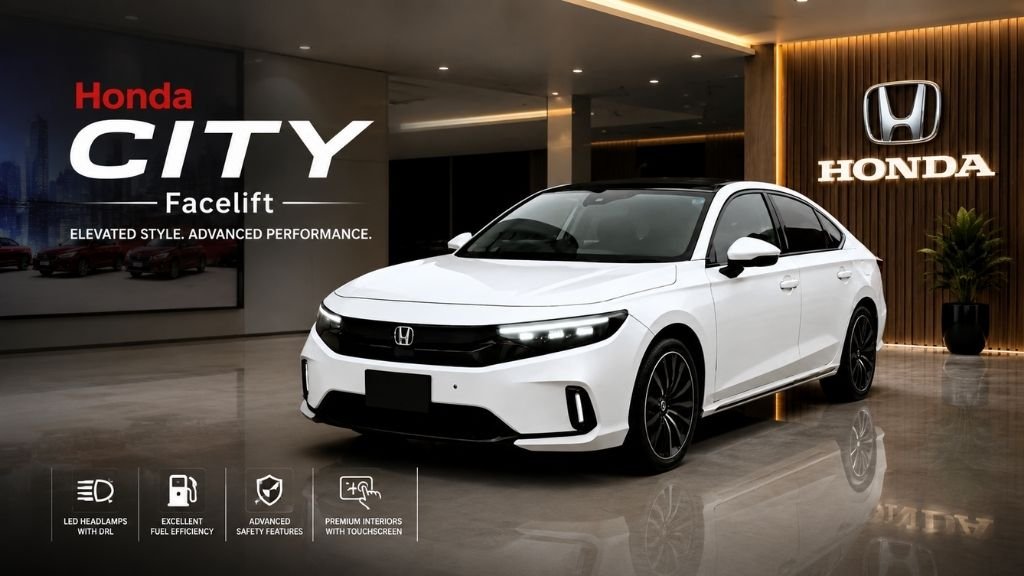
Honda Cars India is gearing up for one of its biggest events of the year — a dual car launch on May 22, 2026. The Japanese automaker will simultaneously introduce the 2026 Honda City facelift and the all-new Honda ZR-V hybrid SUV at a single event. While the City has been a consistent favourite among Indian sedan buyers for over two decades, this facelift aims to bridge the growing feature gap between the City and its more recently updated rivals like the Hyundai Verna, Volkswagen Virtus, and Skoda Slavia.
Why Is the 2026 Honda City Facelift Needed?
The current fifth-generation Honda City received its first facelift back in 2023. Since then, the competition has moved on significantly. The Hyundai Verna underwent a complete generational overhaul, the Skoda Slavia received updates, and the Volkswagen Virtus continues to offer a feature-loaded package. Honda recognised that the City was losing ground in terms of in-cabin technology, and this second facelift is their answer to closing that gap without waiting for a completely new generation.
Industry sources confirm that Honda India had planned this launch earlier but delayed it multiple times. The May 22 date now appears firm, with bookings already open at select dealerships.
2026 Honda City Facelift: Exterior Design Changes
The 2026 Honda City Facelift will not be a complete redesign — Honda rarely does that with interim updates. However, buyers can expect a refreshed face with:


- Updated front grille with a new chrome pattern or blacked-out finish on higher variants
- Revised LED headlamps with sharper DRL signatures
- New front and rear bumpers with a sportier lower apron design
- Redesigned alloy wheels inspired by Honda’s latest global model lineup
- Slightly revised LED tail lamps at the rear
The overall silhouette of the City remains unchanged — Honda is not altering the greenhouse, roofline, or door architecture. This is a soft parts update focused on keeping the car looking contemporary.
Interior and Feature Upgrades — Where the Real Action Is
This is where Honda is making its most significant changes. The current City interior has been criticised for lagging behind rivals in features, especially on mid and top variants. The 2026 update is expected to address most of these concerns:
- Larger touchscreen infotainment system — moving from the current 8-inch unit to a larger display, possibly 10.25-inch, with updated software and better UI
- Fully digital instrument cluster — replacing the current semi-digital setup with a full digital driver’s display
- Ventilated front seats — a feature expected to be offered on the top-spec variant, addressing a key weakness versus the Hyundai Verna
- Powered driver’s seat — adding electric adjustment on the driver’s side on higher trims
- 360-degree camera system — borrowing hardware from the Honda Elevate SUV
- Updated upholstery and trim finishes to give the cabin a premium feel
Honda is not expected to introduce wireless charging or a sunroof on all variants, which remain missing features compared to some rivals. However, the addition of ventilated seats and a larger touchscreen will significantly improve everyday usability.
Engine and Powertrain: No Changes Expected
The 2026 Honda City facelift will retain its proven powertrain lineup:
| Powertrain | Engine | Power | Gearbox |
|---|---|---|---|
| Petrol | 1.5L i-VTEC NA | 121 hp / 145 Nm | 6-speed MT / CVT |
| Strong Hybrid | 1.5L i-MMD Hybrid | 126 hp (combined) | e-CVT (automatic only) |
The 1.5-litre naturally aspirated petrol engine is well-proven for its refinement and fuel efficiency. The strong hybrid variant, which Honda claims delivers around 25-26 kmpl, has no direct rival at its price point and continues to be a compelling choice for urban buyers seeking maximum fuel savings.
Expected Price of 2026 Honda City Facelift
| Variant | Expected Price (Ex-Showroom) |
|---|---|
| City Petrol Base (V) | Rs 12.50 lakh |
| City Petrol Mid (VX) | Rs 14.00 – 15.00 lakh |
| City Petrol Top (ZX) | Rs 16.50 – 17.50 lakh |
| City Hybrid (e:HEV) | Rs 20.50 lakh onwards |
These prices are largely in line with the current City lineup. Honda is unlikely to raise prices significantly on a facelift update, keeping it competitive in the Rs 12–20 lakh sedan segment.
Honda City Facelift vs Rivals: Quick Comparison
| Model | Price Range | Key Strength |
|---|---|---|
| Honda City Facelift 2026 | Rs 12.50 – 20.50 lakh | Refinement, hybrid option, reliability |
| Hyundai Verna | Rs 11.00 – 18.00 lakh | Features, turbo engine, styling |
| Skoda Slavia | Rs 11.50 – 19.50 lakh | Performance, build quality, safety |
| Volkswagen Virtus | Rs 11.60 – 19.00 lakh | Performance, German engineering |
Honda ZR-V: The Real Star of May 22
Alongside the Honda City facelift, Honda is introducing the ZR-V — its new flagship SUV for India. The ZR-V will be imported as a Completely Built Unit (CBU) from Honda’s overseas manufacturing facilities. Priced between Rs 40 lakh and Rs 50 lakh (ex-showroom), it takes on the Volkswagen Tiguan, Skoda Kodiaq, and Jeep Meridian.
The ZR-V carries a 2.0-litre 4-cylinder strong hybrid powertrain producing 180 hp and 240 Nm of torque via an e-CVT gearbox. Honda claims mileage of around 22-25 kmpl, which would be significantly better than most petrol rivals at this price point. The cabin gets a 9-inch infotainment screen, 10.25-inch digital driver display, Honda Sensing ADAS (Level 2), wireless Apple CarPlay and Android Auto, and wireless charging.
MotorFocus Verdict: The 2026 Honda City facelift is a meaningful update that addresses the most important criticisms of the current model — feature gap versus rivals. If Honda prices the top-spec variant with ventilated seats and the larger touchscreen below Rs 17.50 lakh, it remains an excellent buy. The ZR-V is more of a brand statement, but buyers wanting a premium hybrid SUV without spending BMW money will find it very tempting.




Leave a Feedback